Solana Mobile Seeker · Engineering MVP · P0.4

A phone case that becomes a console.

A protective Seeker shell keeps a replaceable USB-C bridge plugged into the phone, then locks into an optional keyboard, battery and controller dock through a protected keyed interface.

USB architecture auditedMetrology gatedBLE HID MVP

Strong spine · removable bulk · no USB-C structural load
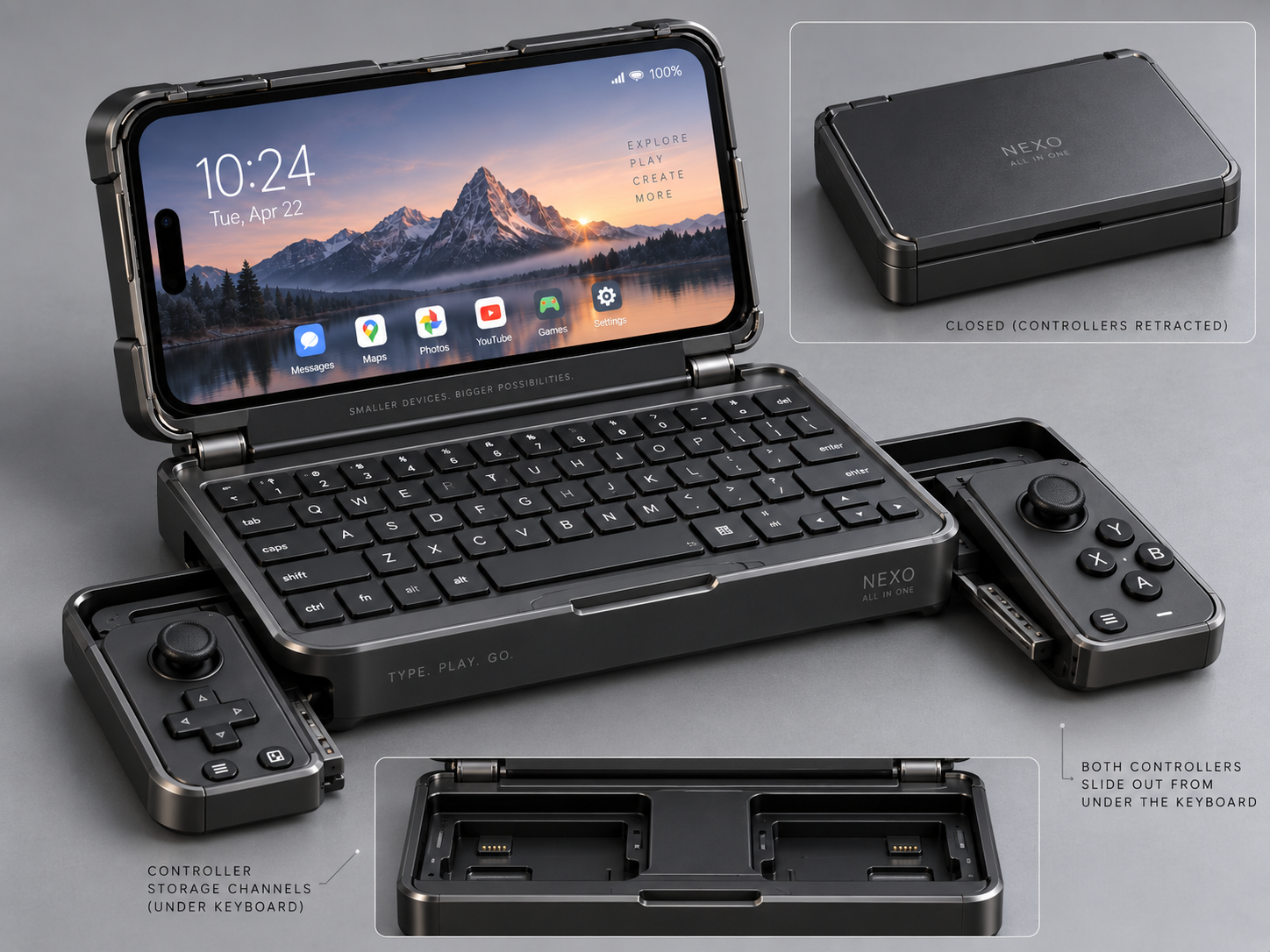
Industrial design concept showing a Seeker phone in a clamshell keyboard dock with detachable game controllers
178 × 112closed footprint · mm
33–38closed thickness · mm
40–44thumb keys
3.5–4.5 Ahmain LiHV target
≤430 gaccessory mass target
Primary workspace

Design the system before filling it with parts.

A deliberately empty, game-like workspace starts with only the Seeker screen, keyboard surface and two control zones. Agents propose bounded changes; a human approves each iteration.

Enter the System Studio →

Interactive model

See how all 105 modeled pieces fit together.

Orbit the full device, pull the assembly apart, expose the internals and trace every system back to the candidate BOM.

Open the 3D assembly →

Executable inputs

Break the keyboard and controls before building them.

The pre-schematic simulator exposes matrix ghosting, scan/debounce/BLE latency, RC settling, ADC quantization, stick deadzone and controller runtime assumptions.

Run the circuit simulator →

Simulation boundary: a passing run advances the design to schematic capture and test coupons. It does not replace SPICE, PCB analysis or instrumented hardware.
01 · Product split

Protection every day. Performance when wanted.

The slim phone shell now includes a passive replaceable USB bridge. All powered switching, the folding mechanism, battery and controls stay in the removable dock.

A / EVERYDAY MODULE

Seeker USB bridge shell

TPU/PC protection, exposed fingerprint control, structural receivers, floating male USB-C plug, short flex and recessed touch-safe dock contacts. The phone port is occupied while installed.

B / PERFORMANCE MODULE

Keyboard + battery + controllers

The hinge, BLE electronics, protected phone-output path, 40–44-key board and two slide-out controllers remain together as one optional base.

STRUCTURE: PHONE → SPINE → RECEIVERS → LOCK → TRUNNIONS → TORQUE TUBE · ELECTRICAL: PHONE USB-C → FLOATING FLEX → KEYED CONTACTS → PROTECTED DOCK
02 · Packaging

One shared layer, not a stack of slabs.

The controller bays and central protected battery bay sit side by side under a 0.5–0.7 mm load-spreading plate. Typing loads route around the pouch cell.

40–44 key sculpted dome keyboard · 164 × 70 × ≤4.4 mm
LEFT CONTROL
39 × 106 × 13.5
BATTERY + POWER PCB
86–96 × 64–72 bay
0.8 mm swelling allowance
RIGHT CONTROL
39 × 106 × 13.5
03 · Mechanism

Detachable without a fragile laptop hinge.

Two 24 mm tapered receivers couple to a performance-dock torque tube. An over-center cam removes play; an independent safety blocks accidental release.

400 Nlocked axial pull target
1.0 N·mproof torque target
30,000fold cycles
10,000dock cycles
0.35–0.50 N·mholding torque
≤5 sectool-free docking
Magnets may help alignment but carry no credited structural load. The phone's USB-C connector floats on a replaceable flex and is never used to align or retain the device.
04 · Power + USB

The phone connection is permanent in the shell, but electrically dead until docked.

The dock proves the mechanical lock, mates ground first, then enables CC/data and finally controlled phone VBUS. BLE remains the reliable MVP keyboard/controller path.

SEEKER USB-C PLUG
floating + replaceable
→
KEYED CASE CONTACTS
touch-safe · ground first
→
ISOLATION + PD SOURCE
locked state only
MAIN CELL
→
DEDICATED BOOST
TPS61088
→
SEEKER USB-C
TPS25752A candidate
No simultaneous wired-HID-plus-charging claim is released yet. Android USB roles depend on device hardware; production Seeker must be tested with a USB analyzer. Wireless charging is the official undocked charging path while the shell occupies USB-C.
05 · Candidate BOM

Every current part line, searchable.

This is a sourcing ledger, not a cost promise. Nineteen of 59 lines currently have defensible dated prices; custom mechanics, cells, PCBs, tooling and compliance remain open. Use the Order Pack for actual five-build quantities.

Loading…
LineDescriptionCategoryStatusManufacturerMPNObserved unit
$76.37 known-price subtotal across 19 priced lines only. This mixes price-break quantities and is explicitly incomplete; the separate EVT0 order pack uses observed unit prices and prototype quantities.
06 · Open risks

The unknowns are part of the design.

P0.4 makes uncertainty visible instead of hiding it behind a polished render.

07 · Build path

Measure, prove, then refine.

EVT0 · Geometry
  • Import official STEP/DWG
  • Verify three production Seekers
  • Print cavity and fingerprint coupons
EVT1 · Function
  • Prototype trunnion + torque tube
  • Keyboard + Hall-input coupons
  • Power-path evaluation boards
EVT2 · Integration
  • Custom PCB and FPC
  • Qualified cell sample
  • Thermal, RF, drop and life fixtures
Current truth: official case-maker STEP/DWG are now preserved and pinned, but no physical prototype, tolerance study, custom PCB, battery qualification, RFQ, tooling or certification has been completed.